Utah town hopes renewable energy improves its fortune without changing its charm

Scotty’s Diner in Milford gets a lot of take-out orders, but those have looked a little different lately.

“They’ll call in 40 cheeseburgers, 40 french fries. That’s big for us,” owner Melissa Wunderlich said, laughing. “We’re like, ‘Hey, give us an hour.’”

Milford is a rural town of around 1,400 people in southwest Utah’s Beaver County. You can count the number of restaurants on one hand.

Since opening the diner two years ago, however, Wunderlich has had to double her staff to keep up with demand for those burgers and fries.

“From the get-go, we’ve been super busy,” she said. “And I think it’s because of the geothermal thing.”

That “thing” is the world’s largest enhanced geothermal project, which is being built just north of town. For local business owners, the workers coming to Milford for construction have provided a big boost.

Texas-based company Fervo Energy broke ground on the project called Cape Station last year. Once completed, it’ll generate electricity by warming water in hot underground rock and using the steam to turn turbines. Fervo recently signed a landmark deal to send much of that power to a giant electric utility in California starting in 2026.

This type of renewable energy could help with lofty goals like cutting emissions and curbing climate change. It also creates a landing spot for workers leaving the fossil fuel industry — people like Eric Williams, who moved to this part of Utah from California to work at the Fervo site.

He now oversees safety at the project, which has borrowed some technology and techniques similar to what’s used to drill for fossil fuels.

“You say you work in the oil and gas industry. Sometimes people go, ‘Ehhhh,’” Williams said, grimacing. “But when you say geothermal and when you say renewable, sustainable … a lot of people go, ‘Wow.’”

As the project ramps up over the next year and a half, Milford will welcome a lot more workers like Williams — 200 construction jobs total.

The geothermal plan marks the latest chapter in Milford’s long history of economic ups and downs.

First, there was mining. Then came the railroad. When Mayor Nolan Davis moved to Milford to work at Union Pacific in 1979, he said the rail company employed more than 200 people in town.

By the time he retired three decades later, layoffs had cut that workforce by more than half. Things felt pretty bleak, he said.

“I made the comment, ‘I’m ready to turn the lights out,’ Davis said. “Our stores were closing down. We went from three cafes, four clothing stores, two grocery stores … we went down to hardly nothing.”

Fortunately, he said, a new industry arrived to help Milford carry on: pig farming. In 2022, however, the company paying for those hog houses — global food giant Smithfield — announced it was leaving Milford, too.

So, the town’s future was once again thrown into uncertainty — until the geothermal news.

“I was turning somersaults,” Davis said.

Steam rises from the Cape Station geothermal project north of Milford, Aug. 13, 2024.

Welcoming a cutting-edge renewable energy project might seem like a big shift for a community that has typically dealt with farms, mines and trains. And there are folks who remain hesitant about the growth it’ll bring, Davis said.

“The poor world’s changing, and so we want to hang on to what we have,” he said. “But we’ve still got to have something to sustain the community. You can’t just say, ‘No, everybody stay away,’ because pretty soon you’re going to end up with a ghost town.”

Milford doesn’t want to put all its eggs in the geothermal basket, either. After all, the 200 construction jobs are temporary. Fervo estimates there will be 15 to 30 permanent jobs when the site is up and running.

So, local leaders are looking to diversify the economy by adding other types of jobs, too — things like agricultural tech, service industries and tourism.

“We want to be mindful — as we look to the growth of what Fervo is doing — that we are not making the same mistakes that our predecessors made,” Beaver County Strategic Development Director Jen Wakeland said. “So that we can level out some of those peaks and valleys.”

As you might imagine, adding hundreds of workers to a town this size also creates immediate challenges.

First and foremost: Where will they live? The community is still figuring that out.

“What does that look like? A headache,” Davis said. “It’s a challenge that can’t be handled just by Milford City. It’s got to be handled countywide.”

Milford has scouted a couple of potential sites where new housing subdivisions could be built. Workers who don’t live there might stay in RVs nearby or commute from other communities, such as Cedar City or Beaver.
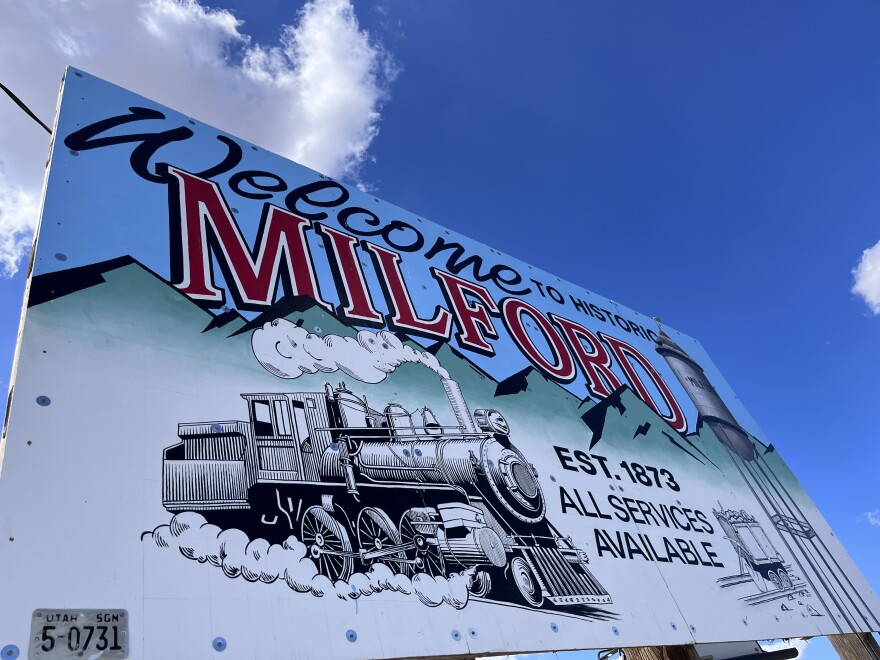
A sign welcomes visitors to Milford with an image of a locomotive, Aug. 13, 2024. The town lost many of its railroad jobs in recent decades but hopes renewable energy can create a sustainable economic future.

No matter what the future looks like, Wakeland said the main thing is making sure economic growth actually helps the people who call Milford home.

“We don’t want just the jobs and the money. We’ve had ‘just the jobs and the money’ and that went away. We want to build this community,” she said. “We can show the metrics and all the dollars and figures. … I don’t know that that’s as important as the kids being able to walk down to the pharmacy and buy a milkshake.”

Or something off the menu at Scotty’s.

At the diner’s small pick-up window, Melissa Wunderlich pointed out some of the most popular menu items, including a deep fried pickle and a patty melt named after her dad.

She was born and raised in Milford, so it feels a bit strange to watch her community change from behind this counter.

“On a daily basis, we’re like, ‘Half the people we just waited on — we don’t even know who they are,’ Wunderlich said, “which is crazy for a small town like this, because before you knew everyone.”

But she’s thankful those changes have helped local businesses like hers thrive in a time when many rural communities nationwide face hard times.

People in Milford want to keep their small town “small-town,” she said. They also want their kids to be able to someday get a job here that allows them to stay.

If geothermal might make that possible, it’ll be a welcome neighbor.
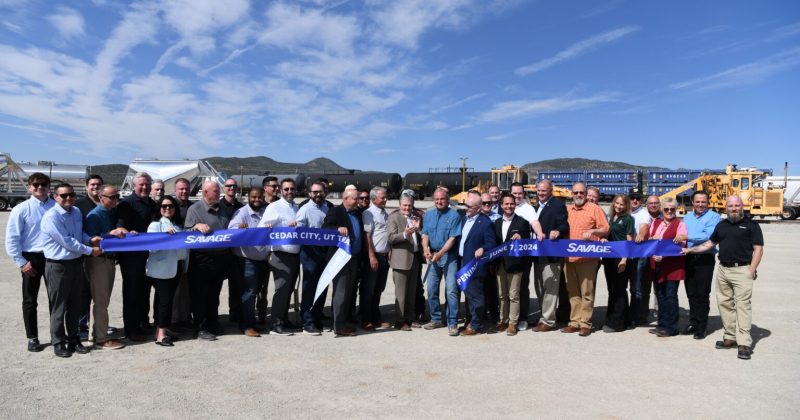
Grand opening of Savage Cedar City, UT, Transload sets stage for regional economic growth

Savage, the Utah Inland Port Authority (UIPA), Iron County and Cedar City are proud to announce the grand opening of the new Savage Cedar City, UT Transload facility, providing transload services between trucks and railcars, on-site storage for shippers, and direct access to Union Pacific Railroad. By connecting area businesses and agriculture producers to broader national and global markets, this latest addition to the Savage Transload Network will help optimize supply chains, drive regional economic growth, bolster industry efficiency and foster sustainable transportation solutions.

“We’re excited to connect Iron County and Southern Utah communities to the national rail network at our new transload facility and create more efficient and sustainable supply chains, with rail providing a more environmentally friendly alternative to long-haul trucking,” said Jason Ray, president of Savage’s Infrastructure Sector. “Improving access to rail transportation will also make Cedar City, St. George and surrounding communities more attractive for businesses looking to expand in the region, supporting job creation and sustainable economic growth. We appreciate the local, state and federal leaders whose

support has been instrumental to the success of this project.”

This new development is an integral part of UIPA’s Iron Springs Inland Port Project Area, focusing on fostering sustainable economic growth and logistics efficiency.

“The Utah Inland Port Authority is dedicated to enhancing Utah’s position in the global supply chain network,” said Ben Hart, executive director for the Utah Inland Port Authority. “The addition of this new Savage transload facility to our logistics capabilities is a key component of our strategy. It demonstrates our commitment to facilitating economic growth while fostering environmental sustainability in transportation.”

The grand opening event, held on June 7, 2024, showcased the new facility’s capabilities, including 70 railcar spots available for transloading a wide variety of materials and products including dimensional freight, dry and liquid bulk, hazardous materials and food-grade products. The event was attended by local business leaders, elected officials, community members, and representatives from various sectors, all eager to witness the impact of the railport on local and regional development.

“This new railport in Iron County is a tremendous opportunity to expand services for our trucking and industrial businesses,” said Cedar City Mayor Garth O. Green. “Companies like Savage are leading the way and we look forward to all that’s to come.”

“The opening of the Savage Cedar City, UT Transload facility is a landmark event for our county,” said Iron County Commissioner Mike Bleak. “It promises not only to create jobs but also to integrate Iron County more deeply into the national economic fabric. We are proud to collaborate with Savage, UIPA and Cedar City on this new transportation infrastructure, which will bring lasting benefits to our communities and businesses.”

The Savage Cedar City, UT Transload is now operational and ready to support the growth and expansion of industries throughout Southern Utah and the surrounding region. To discuss business opportunities, contact Brig Skoy, Savage Director of Terminal Development, at brigskoy@savageco.com or 801-944-6535.

About SavageEstablished in 1946, Savage is a privately held, global provider of supply chain infrastructure and solutions, with more than 4,000 Team Members in about 200 locations across the United States, Canada, Mexico and Saudi Arabia. We strive to always Do the Right Thing, Find a Better Way and Make a Difference. Our Customers and Partners count on us to safely and sustainably move and manage what is essential to their business so they can Feed the World, Power Our Lives, and Sustain the Planet. http://www.savageco.com

About the Utah Inland Port AuthorityAs a state entity, UIPA has a unique role to coordinate a statewide economic development and logistics system to ensure long-term sustainability and statewide value. To learn more about UIPA project areas, developments and its members, visit http://www.inlandportauthority.utah.gov.

About Cedar City & Iron County, UTThe Cedar City & Iron County Office of Economic Development provides rich business resources to foster retail, tourism, manufacturing, distribution and business opportunities. Cedar City & Iron County arewithin one day’s trucking from major western markets, with immediate access to Interstate 15, a regional airport and railroad connectivity. We are recognized for our seamless business development process, an educated workforce pipeline known for longevity, and an unmatched quality of life with fresh air, access to national parks and home of the Utah Shakespeare Festival. Learn more at http://www.cedarcityut.gov/econdev and follow us on Facebook.

ContactsSavage: Jeff Hymas; 801-944-6584; jeffhymas@savageco.comUtah Inland Port Authority: Kaitlin Felsted; 801-837-8997; kaitlinfelsted@utah.govCedar City: Gabbie Costello; 435-477-2217; cgabrielle@cedarcityut.gov

Fervo Energy Breaks Ground on the World’s Largest Next-gen Geothermal Project

400 MW Cape Station project in southwest Utah signals a new era for enhanced geothermal energy

BEAVER COUNTY, Utah (September 25, 2023) — Fervo Energy (“Fervo”), the leader in next-generation geothermal technology, today held a groundbreaking ceremony to mark the start of its exploration drilling campaign at Cape Station, a next-generation geothermal energy project set to deliver 400 MW of 24/7 carbon-free electricity. Cape Station will begin delivering around-the-clock, clean power to the grid in 2026 and reach full scale production in 2028.

Located in Beaver County, Utah, Cape Station will provide roughly 6,600 jobs during construction and 160 full-time jobs throughout its operations, generating more than $437 million in earned wages. Federal, state, and local officials joined Fervo to celebrate this milestone.

“Today’s event highlights the Biden-Harris administration’s all of government approach to helping usher in a legacy of clean and sustainable energy that will live on far beyond our tenures,” said Principal Deputy Assistant Secretary for Land and Minerals Management Laura Daniel Davis. “At the Interior Department, we have been moving quickly to meet President Biden’s goal of achieving a carbon pollution-free power sector by 2035. The Cape Station geothermal energy project we are celebrating today is an important milestone in our effort to make that goal a reality.”

In February, the Utah Bureau of Land Management (BLM) approved the project’s first Environmental Assessment (EA), issuing a Finding of No Significant Impact pursuant to the National Environmental Policy Act. This EA allows Fervo to commence exploration activities at Cape Station site. Across all operations, Fervo maintains a strict commitment to environmental health and safety and robust community engagement.

Utah is home to immense geothermal potential. Researchers estimate that the southwest portion of the state contains more than 10 GW of high-quality geothermal reserves. Additionally, Cape Station will benefit from the Department of Energy’s Frontier Observatory for Research in Geothermal Energy (FORGE). Over the last six years, FORGE has completed groundbreaking research that has dramatically advanced geothermal development in the region.

Utah Governor Spencer Cox said, “Utah is no stranger to energy leadership. For decades, oil and gas workers in the Uinta Basin have produced energy vital to the growth of not just our state but our nation. Geothermal innovations like those pioneered by Fervo will play a critical role in extending Utah’s energy leadership for generations to come.”

Earlier this year, Fervo announced breakthrough result of its commercial pilot project, Project Red. Using drilling technology honed in the oil and gas industry, Fervo performed a 30 day well test, the results of which established Project Red as the most productive enhanced geothermal system in history.

“Beaver County, Utah is the perfect place to deploy our next-generation geothermal technology,” said Tim Latimer, Fervo Energy CEO and Co-Founder. “The warmth and hospitality we have experienced from the communities of Milford and Beaver have allowed us to embark on a clean energy journey none of us could have imagined just a few years ago. Thanks to cutting edge research and data collection from FORGE, Fervo can accelerate the production of the region’s geothermal resources.”

Cape Station is now positioned to channel $1.1 billion to supply chains and local businesses, catalyzing critical growth in the county. Fervo is working with experienced oil and gas companies, including Helmerich & Payne, Devon Energy, and Liberty Energy.

“Fervo’s Cape Station will be a tremendous asset to the Milford Valley, breathing life into the local economy and providing jobs to our hard-working residents,” said Nolan Davis, Mayor of Milford, Utah.

Arieli Capital launching 2nd cohort of START Agri-Tech Scale-Up Program in Utah with 11 cutting-edge ventures

Multi-faceted investment firm Arieli Capital is launching the long-awaited second cohort for its venture scale-up program, START Agri-Tech, powered by Frontier RNG a joint venture between Arieli Capital and Ramat Hanegev Regional Council, in partnership with Utah Tech University, Haifa Group and Exit Ventures, sponsored by The World Trade Center Utah. Following the success of its first cohort back in 2023, the program is returning for another batch, and this time, in St. George, Utah, on the 15-18 of April, with a cohort of 11 highly innovative and promising startups. Join the final expo and pitch event here.

A launchpad for climate-focused ventures, START Agri-Tech leverages global resources to support the growth of startups in the fields of desert-tech, water-tech, regenerative agriculture, smart farming, plant health and nutrition, helping them commercialize cutting-edge solutions and build strong businesses to drive their value to market at scale.

Aiming to address the world’s environmental challenges by promoting highly advanced technological solutions, the program is taking place in Utah Tech University’s Atwood Innovation Plaza, and will provide participating startups with dedicated 1-on-1 business and networking opportunities with international investors and global corporations as well as to a final pitch event where they’ll be invited to present to a variety of future partners and clients.

The first cohort of the program included 8 ventures, who’ve collectively raised a combined $9.5M in investment capital and have gone on to hit impressive milestones after participating. Among them was Nanomnia, who have succeeded in securing their second pilot with a multinational agriculture corporation, as well as We-Agriwhose data-driven platform allows farmers to track and sell their carbon credits, recently received validation for its biggest project, Milopri, and secured a significant deal with Bank Hapoalim. To fuel their growth further, Arieli Capital is evaluating investment into some of the program’s participating ventures.

“The selection committee brings an outstanding mix of startup expertise and broad technological capabilities,” notes Paul Burgon, Managing Partner at Exit Ventures. “With the combined resources of dedicated partners Arieli Capital, Frontier RNG, strategic investors, and distinguished agriculture academics, I am confident that the participating startups are poised for
substantial growth.”

“Haifa Group was pleased to take part in the final selection committee for START AgriTech,” says Chanan Sluszny, Innovation Agronomist at Haifa Group. “Throughout the sessions, we engaged with an impressive group of 20 startups, gaining valuable insights from these leading innovators in the AgTech space.”

The program has attracted applications from ventures across more than 11 countries. The selected group includes 11 uniquely innovative startups, each led by talented founding teams in their Seed to Series A phases, which have collectively raised over $44M and generated $4.7M in revenue. Now gearing up to take their operations to the next level, the second cohort for START Agri-Tech includes the following ventures:

Agri-Light Energy Systems: Developing a solar tracking system with a proprietary agri-voltaic algorithm that enables dual usage of land, optimizing both electricity generation and crop cultivation.

Arugga AI Farming: developing ground robots to treat and monitor individual plants by replicating pollination in greenhouses in a manner that lessens the need for chemicals and the spread of crop disease, easing the challenges in crop production.

Bactelife Industries: making nutrients available to plants, enhancing soil, and conserving water.

BioLeaf: developing natural, eco-friendly, postharvest solutions that prolong the shelf life of fresh produce.

Bioplasmar: converting compost into completely biodegradable planting pots that can be planted directly in the soil and eliminating the need for plastic pots.

Contact Organics: constructing innovative methods to create a non-toxic product range that eliminates the perpetual problem caused by weeds that compromise crops.

Eden Technologies: revolutionizing water purification to make affordable drinking water accessible to all around the world.

Projini Agchem: redesigning chemistry for health by developing new pesticides in order to support a greater quality food production at higher volumes, to support the world’s growing population.

Saffron Tech: cultivating premium saffron year-round in indoor vertical farms, supporting sustainable agriculture and saffron-based products.

TomGrow: enabling people, communities, and organizations to grow diverse and healthy plants anywhere in the world, in any climate and for any purpose – from food to medicine and cosmetics and wellbeing.

Vexxel Biotech: reshaping the production landscape and enabling healthier food options while ensuring sustainable and environmentally friendly production methods.

An active investor into desert and agriculture technologies, alongside its innovation center, Frontier, Arieli Capital has a lively presence in and long-standing relationship with the state of Utah. Also having offices in New York, London, Arieli Capital has deep roots in Israel and is uniquely positioned to spearhead climate initiatives and support ventures in parallel fields, due to a native familiarity with desert landscapes that spur agricultural innovation.

“Climate and food security are some of the world’s most pressing issues making the need for innovation in these verticals ever more important. With desert conditions covering roughly 30% of Utah’s land mass and 60% of Israel’s land mass, these two global ecosystems provide the perfect platform for desert, climate and agriculture innovation” says Or Haviv, partner and head of global innovation at Arieli Capital. “We’re beyond excited to be coming back for another cohort with 11 outstanding ventures, and our amazing partners – all sharing the same vision. Our first cohort showcased just how much value can be created through this program, and we knew from then that we’d return with another group. Utah is an exceptional environment for us in every sense, with an outstanding entrepreneurial ecosystem and great local organizations who share our values and vision. This opportunity creates a direct connection between Frontier’s desert R&D facilities in Israel and Utah Tech University’s desert innovation facilities, unlocking strategic access to years of expertise, research, farms and facilities, sparking a new era of building cutting-edge technology companies and tackling global climate and agricultural challenges. We’re thrilled to work alongside our Utah partners on this impactful program deepening Arieli’s existing Utah activity and investments.”